


Featured
Routing across providers without rewriting your stack
Connect OpenAI, Claude, Gemini, and other AI providers through one unified API. Route requests intelligently, switch models seamlessly, and scale without rewriting your stack.
Introduction
Modern AI products rarely rely on a single model provider. Teams often experiment with OpenAI, Claude, Gemini, and open-source models to balance cost, speed, and quality. The challenge is that every provider exposes different APIs, authentication methods, and response formats.
FeatDev removes that complexity by giving developers a single API that routes requests across providers while keeping existing integrations intact. This article explains how unified routing works and why it makes AI infrastructure easier to scale.
The Problem
Every provider has strengths, pricing differences, and occasional downtime. Integrating each one separately creates unnecessary maintenance and slows product development.
Common challenges include:
Different SDKs and authentication methods for every provider.
Rewriting application logic when switching models.
Maintaining separate monitoring and analytics.
Increased infrastructure complexity as products grow.
Vendor lock-in limiting flexibility and experimentation.
As teams adopt more AI models, maintaining multiple integrations quickly becomes expensive and difficult to manage.
How Unified Routing Works
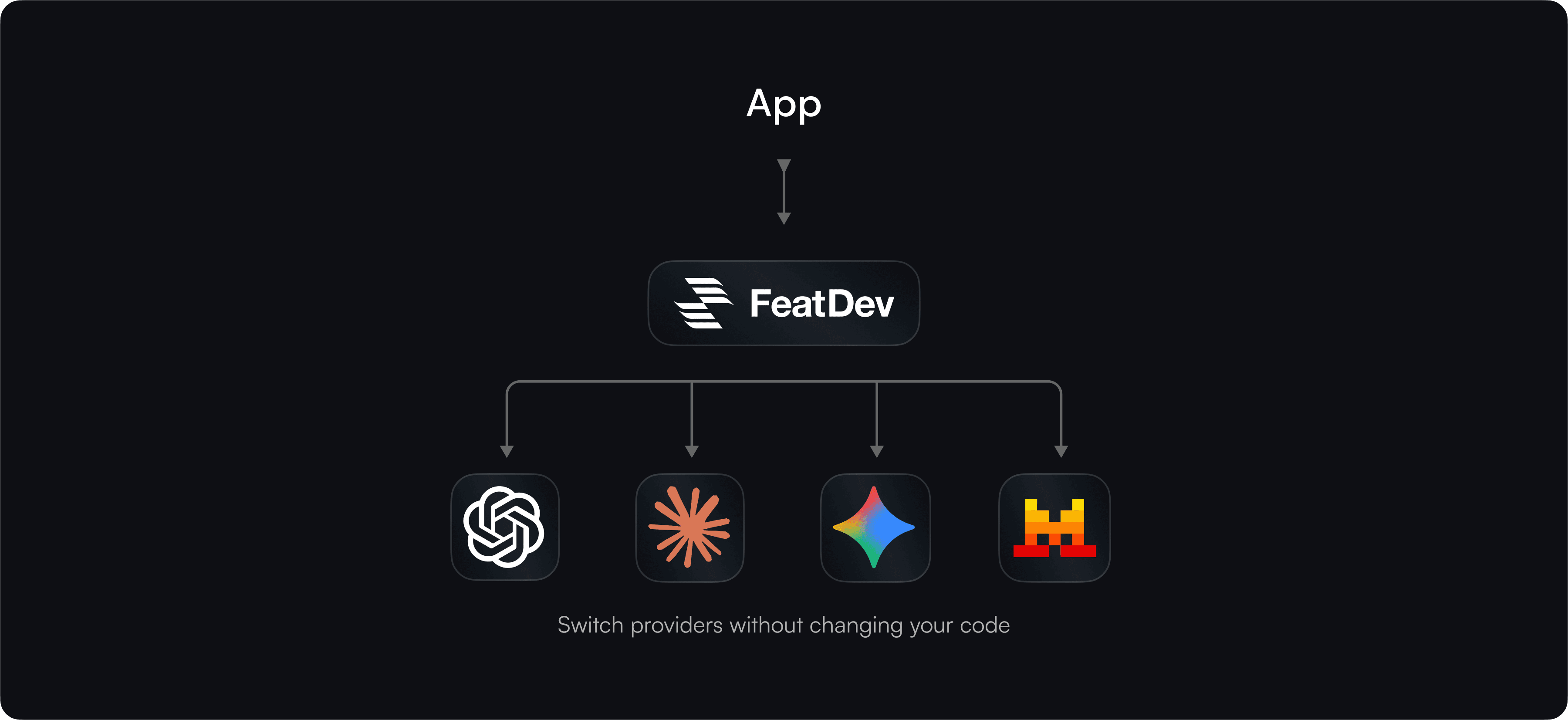
FeatDev sits between your application and every AI provider, exposing a single consistent API.
The routing layer automatically:
Authenticates requests using one API key.
Routes requests to the selected provider or model.
Normalizes responses into one consistent format.
Handles retries and provider failover automatically.
Collects analytics, usage metrics, and request logs.
Because every request passes through the same endpoint, your application doesn't need to understand provider-specific implementations.
Why It Works
The biggest benefit isn't simply switching providers—it's removing infrastructure complexity.
Developers only integrate once, while FeatDev handles routing, compatibility, monitoring, and optimization behind the scenes. Teams can compare models, reduce operational overhead, and adopt new providers without rebuilding existing systems.
What Changed
After adopting unified routing, development teams typically experience:
Faster AI provider integration.
Less maintenance across multiple APIs.
Easier experimentation with new models.
Improved monitoring through centralized analytics.
Reduced vendor lock-in and greater flexibility.
Instead of rebuilding infrastructure for every provider, teams can focus on shipping product features.
"Automatic failover turned a provider outage into a non-event for our users. That alone justified the move."

Elena Brandt
Elena Brandt
Conclusion
Supporting multiple AI providers shouldn't require multiple integrations.
FeatDev gives developers one unified API for every model provider, making it easy to route requests, monitor usage, and switch models without rewriting code.
Whether you're building an MVP or scaling an enterprise AI platform, unified routing helps your team move faster while keeping your infrastructure simple, flexible, and reliable.
Author
SR
Daniel Cho
Co-founder & CTO, FeatDev


